

Figma vs Canva 2025: An Honest Comparison for Creatives & Pro Teams

As Visual Thinkers navigating the dynamic digital landscape of 2025, the choice of your primary design tool is more critical than ever. In an era where visual communication reigns supreme, the tools you wield directly impact your efficiency, creativity, and collaborative potential. This article dives deep into the perennial debate: Figma vs Canva 2025. We’ll provide an honest comparison, exploring key features, recent updates, and the often-overlooked benefits that empower everyone from ambitious freelancers to sprawling design and marketing teams.
Whether you’re a seasoned graphic designer, a budding digital marketer, or a brand builder striving for visual excellence, understanding the nuances between these two industry giants is paramount. Get ready to uncover which platform truly aligns with your creative workflow and strategic objectives in the coming years.
Figma: Innovation, Precision, and Deep Collaboration for Professionals
For many professional Visual Thinkers, especially those in UI/UX design and product development, Figma stands as an unrivaled powerhouse. It’s built from the ground up to facilitate intricate design processes, offering a level of precision and control that is essential for crafting seamless user experiences.
Figma’s core strength lies in its real-time, cloud-based collaboration. Teams can work simultaneously on the same file, seeing changes happen live, which dramatically speeds up design sprints and feedback loops. This feature alone has transformed how large product design teams operate, allowing for a fluid, iterative workflow.


UX Design & Deploy Process – Template | Figma
Beyond collaboration, Figma excels in advanced features like powerful vector editing, component-based design systems, and robust prototyping capabilities. Designers can create interactive prototypes that mimic the final product’s functionality, making user testing and stakeholder presentations incredibly effective. Developer handoff is also incredibly smooth, with inspect tools allowing developers to easily extract CSS, iOS, or Android code snippets.
- Advanced UI/UX Design: Unparalleled precision for pixel-perfect interfaces.
- Real-time Collaboration: Multiple designers, one canvas, zero conflicts.
- Prototyping & Interactions: Create highly interactive user flows.
- Design Systems: Build scalable and consistent design libraries.
- Developer Handoff: Seamless integration with engineering workflows.
Canva: Flexibility and Efficiency for Rapid Visual Creation
For **Visual Thinkers** seeking speed, simplicity, and a vast library of templates for everyday graphic design, Canva is an undisputed champion. It has democratized design, empowering non-designers and marketing teams to create stunning visual content without the steep learning curve associated with professional design software.
Canva’s intuitive drag-and-drop interface, coupled with its immense collection of customizable templates, stock photos, illustrations, and fonts, makes graphic design accessible to everyone. From social media posts and marketing collateral to presentations and short videos, Canva allows for rapid content creation, which is vital in today’s fast-paced digital marketing environment. This platform is particularly a boon for freelancers and small businesses needing to maintain a consistent brand presence across multiple channels.
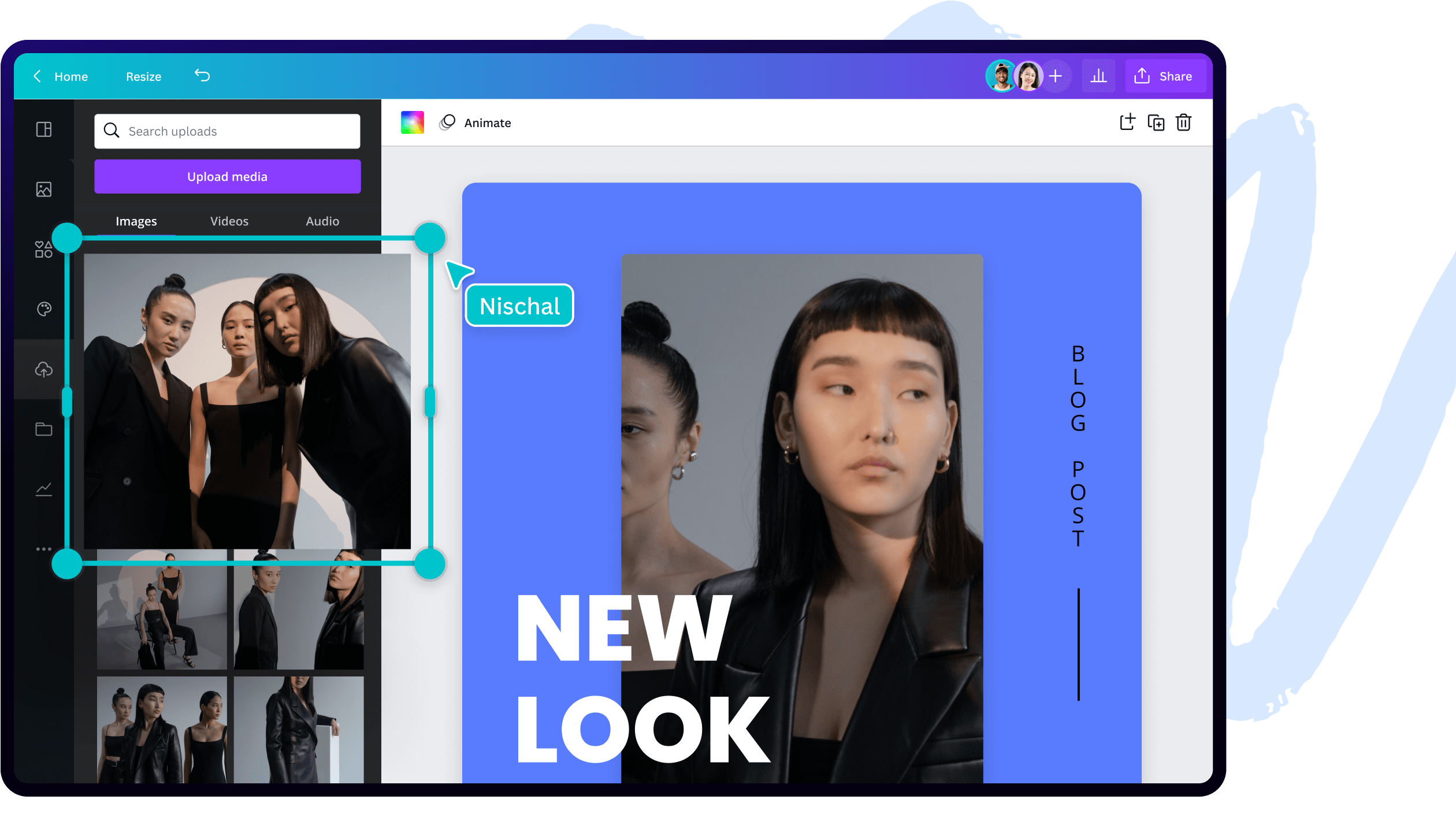
While often seen as a tool for simpler designs, Canva has continuously evolved, introducing features like Brand Kits, basic animation, and collaborative workspaces. These additions enable marketing professionals to maintain brand consistency and work together on campaigns with remarkable ease.
Key Canva Strengths:
- Ease of Use: Intuitive interface with a minimal learning curve.
- Template Library: Thousands of professional, customizable templates for every need.
- Speed & Efficiency: Rapid content creation for marketing and social media.
- Asset Rich: Extensive library of stock photos, videos, graphics, and fonts.
- Accessibility: Empowers non-designers to create high-quality visuals.
Figma vs Canva 2025: An Honest Comparison – Which Excels in Various Scenarios?
To truly understand the choice between Figma vs Canva 2025, we must compare them across several critical dimensions relevant to modern design and marketing workflows.
Interface & Learning Curve
Canva’s strength is its simplicity. Its drag-and-drop interface and vast template library mean almost anyone can pick it up and start creating immediately. Figma, on the other hand, has a steeper learning curve. Its interface is geared towards precision and complex functionality, requiring users to invest time in mastering its tools and features.
Collaboration Features
Both platforms offer collaboration, but with different depths. Figma’s real-time, multi-user editing, shared design systems, and version history are built for complex, iterative product design workflows involving many stakeholders. Canva offers team folders, brand kits, and shared editing, which are excellent for marketing teams creating diverse content, but less suited for granular UI/UX design collaboration.
Design Capabilities (Precision vs. Speed)
Here’s where the core difference lies. Figma provides unparalleled control over every pixel, vector path, and interaction, making it ideal for detailed UI/UX, responsive layouts, and sophisticated animations. Canva prioritizes speed and accessibility. Its strength is in quick assembly of visually appealing graphics, leveraging templates and a user-friendly editor, rather than intricate, custom-built interfaces.
Integrations & Ecosystem
Figma boasts a rich plugin ecosystem and robust API, allowing integration with developer tools, project management software, and advanced analytics. This makes it a central hub for product development. Canva also offers integrations, particularly with social media platforms and cloud storage, streamlining content distribution and asset management for marketing teams.
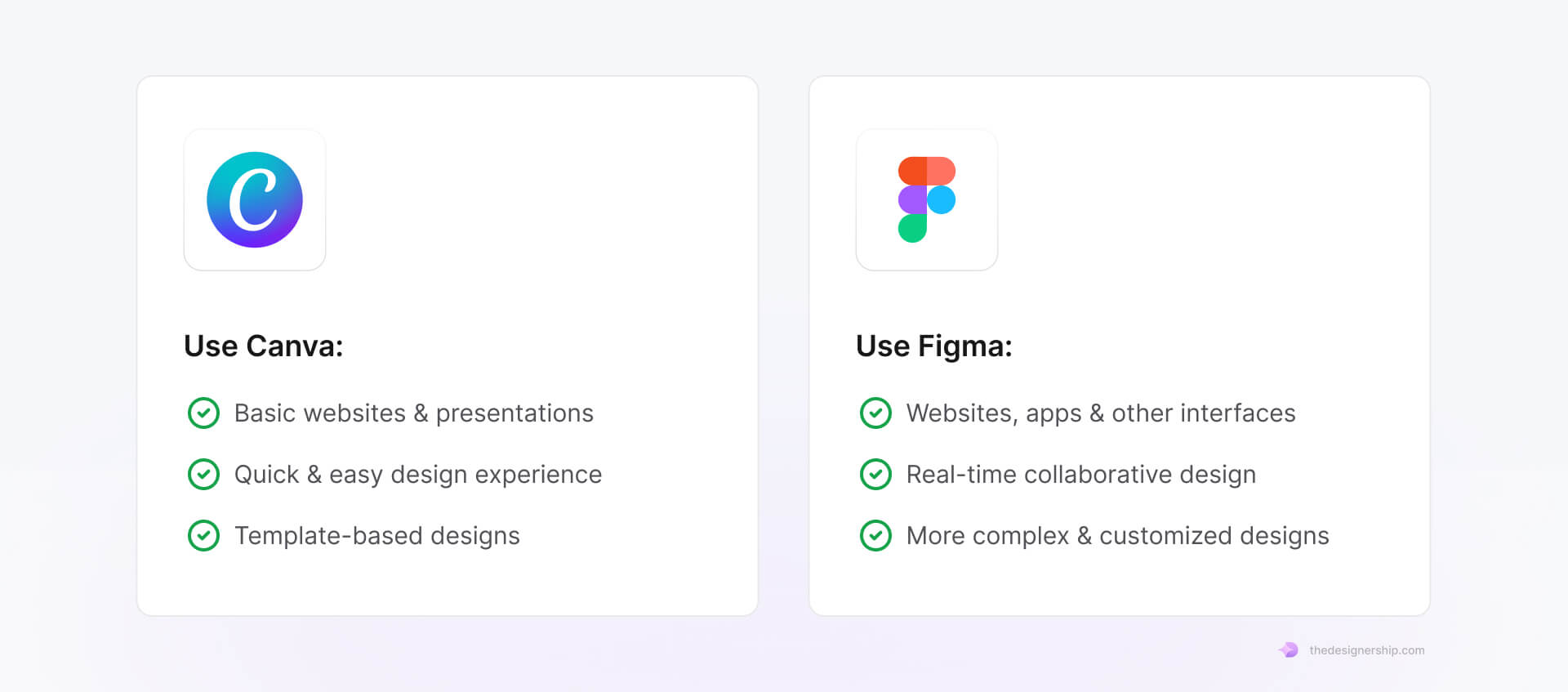
Canva vs. Figma: The 2024 UX/UI Design Tool Face-off
Pricing & Business Model
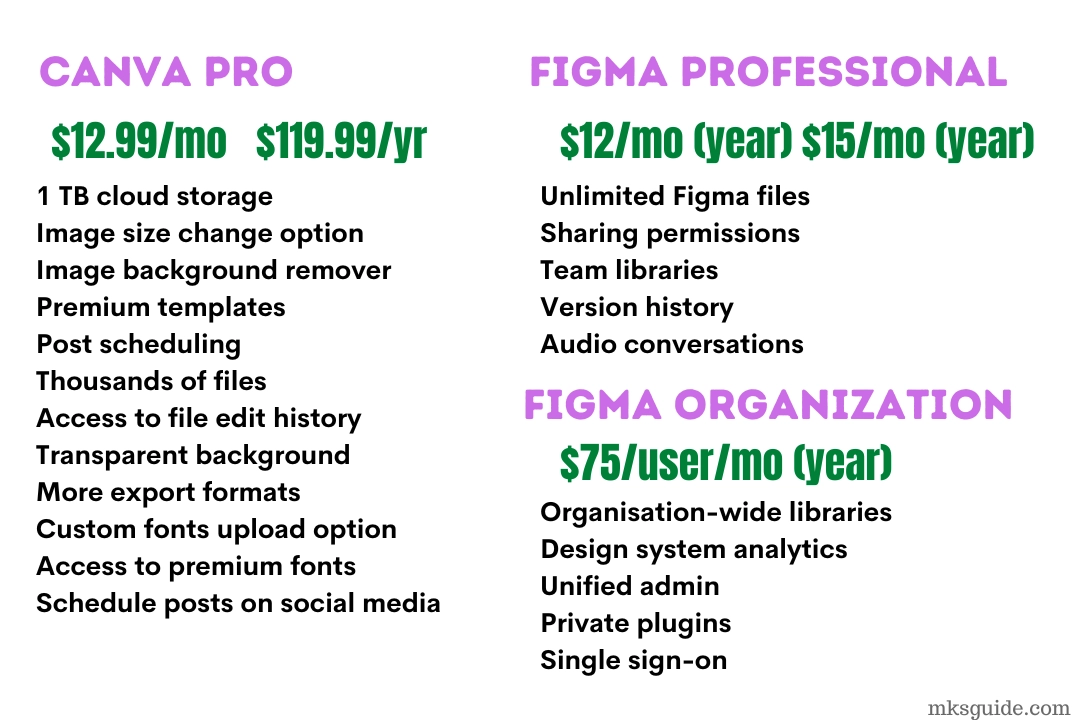
Both offer free tiers with limited functionality, alongside tiered subscription models. Figma’s professional and organizational plans cater to larger design teams with advanced features like shared libraries and analytics. Canva Pro and Enterprise plans offer expanded template access, brand kit features, and more storage, making them attractive for businesses and marketing departments requiring extensive content creation.
Unexpected Benefits: More Than Just Ordinary Design
Beyond their advertised features, both Figma and Canva offer surprising advantages that can redefine how Visual Thinkers approach their work in 2025.
Figma: The Strategic Advantage of Design Systems
For large organizations and growing startups, Figma’s capacity to host and manage comprehensive Design Systems is an often-underestimated benefit. A well-maintained design system in Figma acts as a single source of truth for all UI components, styles, and guidelines. This dramatically reduces ‘technical debt’ by preventing inconsistencies across products and teams.
Furthermore, it accelerates designer onboarding and ensures brand consistency at scale. New designers can quickly grasp the established visual language, reducing ramp-up time and increasing productivity. This strategic advantage positions Figma not just as a design tool, but as a critical infrastructure for cohesive product development in the years to come.
Canva: Democratizing Design and Empowering Non-Designers
Canva’s most profound, albeit sometimes overlooked, benefit is its ability to empower non-designers. In many organizations, a bottleneck often exists when marketing teams or content creators need quick visual assets but are reliant on a busy design department. Canva breaks this barrier.

By providing user-friendly tools and branded templates, Canva allows marketing specialists, social media managers, and even sales teams to create high-quality, on-brand materials independently. This saves invaluable time and resources for core designers, allowing them to focus on complex projects while enabling other departments to rapidly respond to market demands with visually appealing content. This democratization of design is a game-changer for agility and cost-effectiveness in digital marketing.
Who Should Use Figma or Canva in 2025?
The choice between Figma vs Canva 2025 isn’t about which tool is universally “better,” but rather which tool is better for your specific needs. Here’s a breakdown for different user profiles:
Freelancers
- UI/UX Designers: Figma is indispensable for creating professional-grade interfaces, interactive prototypes, and collaborating with development teams.
- Graphic Designers & Digital Marketers: Canva offers incredible efficiency for social media graphics, ad creatives, presentations, and branding materials. It’s perfect for delivering rapid results.
Small Teams / Marketing Agencies
- Canva: Ideal for agencies needing to produce a high volume of diverse marketing content quickly and consistently across various clients. Its brand kit features ensure cohesive visual identity.
- Figma: If your small team focuses on app development, web design, or building bespoke digital products, Figma’s collaborative environment and design system capabilities are paramount.
Large Teams / Enterprises
- Figma: Essential for large product organizations with dedicated UI/UX teams. Its robust design system management, advanced prototyping, and seamless developer handoff are critical for scaling design operations.
- Canva: Can complement Figma by empowering non-design departments (e.g., HR, internal communications, sales) to create branded materials, freeing up the central design team.
Ultimately, many forward-thinking Visual Thinkers and organizations in 2025 find that using both Figma and Canva in a complementary fashion offers the greatest advantage. Figma for core product design and sophisticated UI/UX, and Canva for rapid marketing content, internal communications, and general graphic needs.
The Future of Design: The Evolving Role of AI and Collaboration
Looking ahead to 2025 and beyond, the design landscape continues to be shaped by advancements in Artificial Intelligence and the ever-growing demand for seamless collaboration. Both Figma and Canva are keenly aware of these trends and are continually integrating AI-powered features to enhance user workflows.
AI will increasingly assist with mundane design tasks, content generation, image manipulation, and even suggesting design improvements. This will allow Visual Thinkers to focus on strategic thinking and creative problem-solving. Furthermore, as remote work remains prevalent, the demand for sophisticated, real-time collaboration tools will only intensify, pushing both platforms to innovate further in this space.
In conclusion, the decision between Figma vs Canva 2025 is not about choosing a winner, but about understanding which tool best serves your strategic intent. By embracing flexibility and leveraging the unique strengths of each platform, creative professionals and teams can navigate the complexities of digital design and marketing with unparalleled effectiveness.
Visual Conclusion: Navigating Your Creative Toolkit in 2025
As we’ve explored the depths of the Figma vs Canva 2025 debate, it’s clear that both tools are indispensable, each shining brightly in its own domain. Your ultimate success as a Visual Thinker hinges on a thoughtful approach to tool selection, recognizing that the right instrument for the job can elevate your creative output and streamline your operations.
Need expert design, compelling branding, or dynamic social media strategies that cut through the noise? Our team specializes in transforming your vision into stunning visual realities. We craft bespoke design solutions that not only look incredible but also deliver measurable results for your business.
Elevate your online presence with a professional WordPress website. We offer modern, SEO-optimized, and highly customizable WordPress website creation services. Our designs prioritize reliability and user experience, ensuring your brand stands out and performs exceptionally. Don’t settle for generic templates; invest in a digital foundation that truly reflects your brand’s potential. Contact us today to discuss how we can build a website that not only looks great but also acts as a powerful marketing asset for your business.
Deep Dive: Recommended YouTube Insights
To further enhance your understanding and mastery of these powerful design platforms, we’ve curated a selection of insightful YouTube videos. These recommendations offer practical tips and strategic perspectives to help you leverage Figma and Canva to their fullest potential in 2025.
Sources That Shape Our Insights
Our comprehensive analysis of Figma vs Canva 2025 is informed by a synthesis of expert insights and current industry trends from reputable sources. We believe in providing well-researched content to empower your design and marketing decisions. Explore these resources for further reading:
Discover more from CiptaVisual
Subscribe to get the latest posts sent to your email.