
The “Substance-First” Portfolio: How Solo Creatives Can Rank on AI Search Engines Without Spending a Dime

Search is quietly splitting in two. One side still ranks blue links. The other side skips the links and hands people a finished answer, built from whatever sources an AI model trusts enough to cite. If you’re a freelancer or a one-person agency, that second side is where your next client is probably searching right now.
The good news: this shift favors small creators more than it favors big brands. AI search agents are built to pull from original, verifiable substance, not polished marketing copy. A designer with three real case studies and a well-tagged portfolio can out-cite an agency with a bloated blog and no proof of work. Here’s how to structure your site so an AI system finds you, trusts you, and puts your name in its answer.
1. The Shift: Why AI Search Skips Generic SEO Content
Traditional SEO rewarded keyword density and backlink volume. AI search engines work differently. When someone asks ChatGPT, Perplexity, or Google’s AI Overviews a question, the model breaks that question into smaller sub-questions and searches for each one separately, then stitches the best answers together. This process is often called query fan-out, and it means your page needs to answer one specific sub-question clearly, not everything at once.
That single change explains why AI fatigue is spreading. Readers can feel when a page was written to hit a keyword rather than to solve a problem, and AI models are trained to spot the same pattern. Generic advice, recycled definitions, and vague claims get treated as noise. What gets pulled into an answer is content with a clear point of view, real numbers, and evidence that a human actually did the work being described.
This is your opening. You don’t need a content team or an enterprise SEO subscription to produce substance. You need a portfolio structured so a machine can tell, at a glance, that the results are real.
2. Structuring a “Substance-First” Case Study
Most freelance portfolios describe a project. A substance-first case study proves one. The difference comes down to structure, not writing talent, and it’s the part AI crawlers are built to recognize.
Build each case study around four visible elements:
- The starting problem, stated in one or two sentences with a number attached (traffic, conversion rate, response time).
- The specific action you took, described in plain language rather than agency jargon.
- The measurable result, ideally with a before-and-after comparison a reader can verify at a glance.
- One original visual asset you created yourself, like a screenshot, a sketch, or a chart, not a stock image.
Each case study should live on its own dedicated page with its own URL, not buried in a single “Portfolio” carousel. AI crawlers process pages individually. A single page with five thumbnails and no text is functionally invisible to a system built to extract sub-answers.
Write the client’s problem the way they’d describe it themselves, not the way you’d pitch it. That phrasing overlap is exactly what helps an AI model match your page to a real user’s question later.
3. Free Technical SEO: Schema and Image Metadata That Actually Work
Schema markup sounds intimidating, but the version solo creatives need is small and free to implement. Schema is code added to a page’s backend that tells search engines and AI crawlers what your content actually represents, rather than leaving them to guess from the visible text.
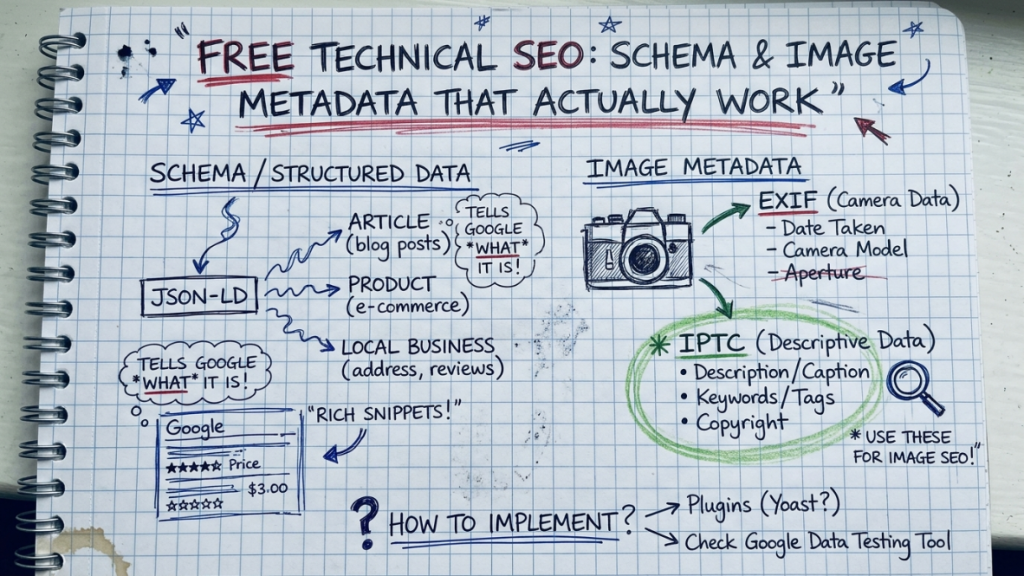
Three schema types matter most for a solo creative’s site:
- Person schema on your About page, naming your role, skills, and location so AI systems can attach your name to your work as an entity, not just a keyword.
- Service schema on each service page, spelling out exactly what you offer and to whom.
- CreativeWork or Article schema on each case study, tagging it as original work with a creation date.
You can generate all three without writing code from scratch. Google’s Structured Data Markup Helper lets you highlight elements on a page and tag them manually, which is a fast way to learn the mapping even if you don’t use its final output. For production-ready code, a dedicated JSON-LD generator will save you time. Whatever tool you use, paste the output into <a href=”https://validator.schema.org/”>Schema.org Validator</a> or Google’s Rich Results Test before publishing, since a broken schema tag is often worse than no tag at all.
Image metadata deserves the same attention. Every case study screenshot should have a file name that describes the image (freelance-logo-redesign-before-after.jpg, not IMG_4021.jpg) and alt text that describes what’s shown and why it matters, in one specific sentence. AI models increasingly extract information from images directly, and a vague or missing alt tag is a missed citation opportunity, not just an accessibility gap.
None of this requires a developer or a paid plugin. It requires about twenty minutes per page and a habit of doing it before you hit publish, not after.
4. Promoting Beyond Google: Building a Closed-Loop Authority System
AI models weigh how often your name and your work show up across the web, not just on your own site. A single well-optimized portfolio page will only get you so far if nothing else online reinforces it. This is where a small, deliberate promotion loop matters more than volume.
Start with LinkedIn. Publish a short, native post summarizing each new case study, using the same problem-and-result framing you used on your site, and link back to the full page. LinkedIn posts get indexed and are increasingly pulled into AI-generated answers about professionals and their work, especially when the post includes concrete numbers.
Next, seek out one or two credible mentions outside your own channels each month. A guest answer in a relevant community, a listing in a niche directory for your craft, or a quoted comment in an industry roundup all count. AI systems weigh how consistently your name, skills, and results appear across independent sources, so five scattered mentions often outperform one big backlink.
Close the loop by linking these mentions back to your case study pages, and linking your case study pages back to your LinkedIn profile and any directory listings. That consistent cross-referencing is what turns a handful of small signals into a recognizable entity an AI model can confidently cite.
5. The 30-Minute Weekly Routine
Substance-first SEO isn’t a one-time overhaul. It’s a small, repeatable habit that keeps your portfolio current and your name visible. Here’s a routine that fits into thirty minutes a week:
- Minutes 0–10: Add or update one case study with a fresh result, number, or client detail. Even a small update signals to crawlers that the page is actively maintained.
- Minutes 10–15: Check that page’s schema and image alt text with the Rich Results Test. Fix anything flagged.
- Minutes 15–25: Publish one LinkedIn post referencing that update, written the way a client would phrase the problem it solves.
- Minutes 25–30: Spend five minutes looking for one place to mention your work this week, whether that’s a community thread, a directory, or a comment on someone else’s relevant post.
Do this consistently for two months, and you’ll have a portfolio built from real, verifiable substance, cross-referenced across the web, and structured for a machine to read with confidence. That’s the version of SEO small creators can actually win.
Suggested Visual: A hand-sketched, notebook-style illustration with one neon-green accent color, showing a glowing magnifier “discovering” a hidden portfolio notebook on textured paper. Use as the featured image, with alt text: “Hand-drawn illustration of an AI search magnifier discovering a solo creative’s portfolio notebook.”
Hashtags: #SEOtips #CreativeFreelancer #AISearch #PortfolioDesign
Keywords: AI search optimization, creative portfolio SEO, solo marketer strategy, free SEO tools
Discover more from CiptaVisual
Subscribe to get the latest posts sent to your email.